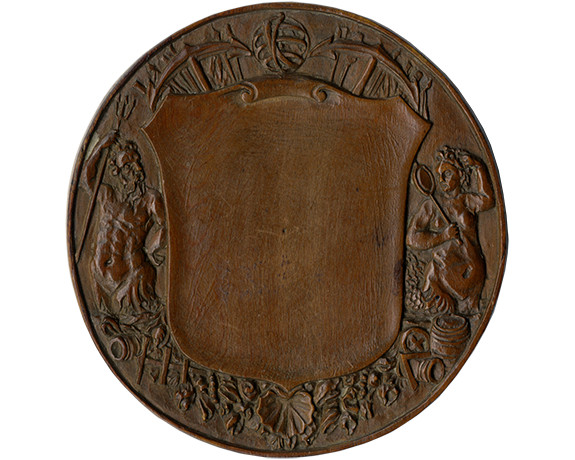
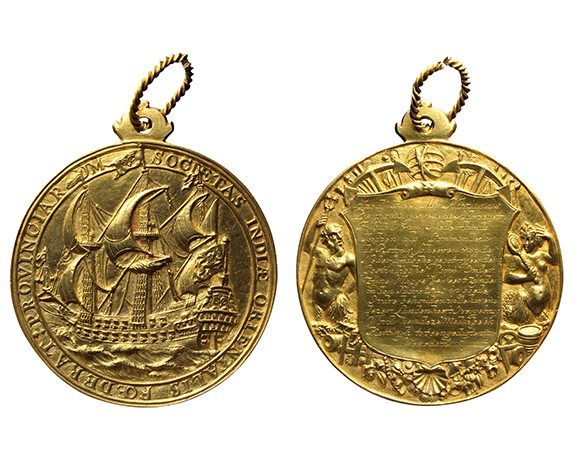
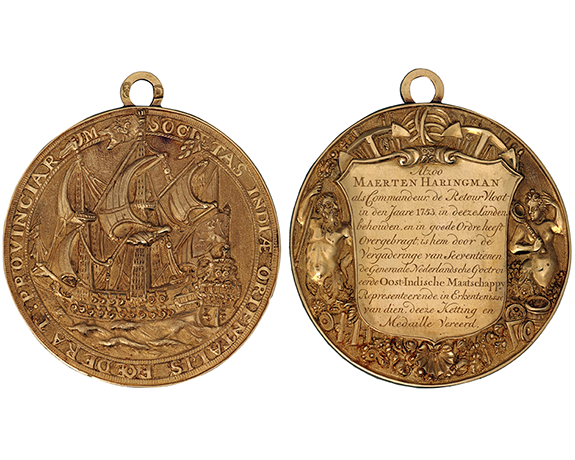
Not even 15 grams. That is the weight of the boxwood model, which has a diameter of just under 8 centimetres. But the designs carved into the wood on both sides are truly stunning. Not only because of the extremely precise details, but also because of the depth of the relief in the designs. The boxwood model is a replica of the reward medal of the Dutch East India Company.
The United East India Company
In 1601, the VOC – the Dutch East India Company – was founded. The VOC had a local office or ‘chamber’ in six cities: Amsterdam, Rotterdam, Delft, Hoorn, Enkhuizen and Middelburg. The governing body was the Heren XVII, an assembly of representatives from the chambers. The VOC established trading settlements across large parts of Asia, with its most important outposts being the Indonesian archipelago and Ceylon.
The Return Fleet
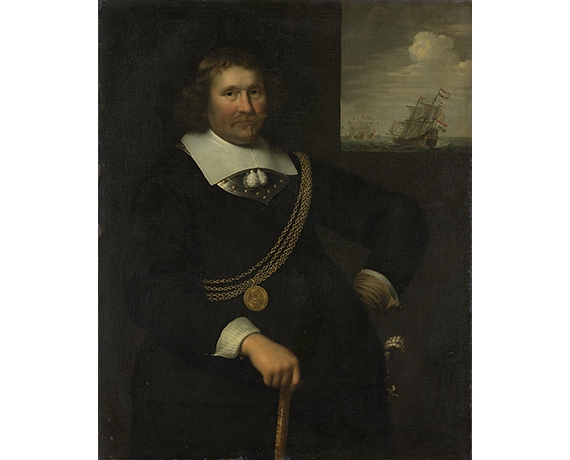
Every year, a fleet set sail from Batavia – now Jakarta – to bring the spices, porcelain and all the other goods stored in the VOC’s warehouses back to the Netherlands. The ships sailed in convoy as a defence against pirates. At the head of the fleet was an admiral or a commander. His main task was to bring the fleet home safely. Upon his return, he reported to the meeting of the Seventeen Lords. If he had done his job well, he was rewarded with a gold chain bearing a medallion worth 500 or 600 florins.
The VOC’s medal of honour
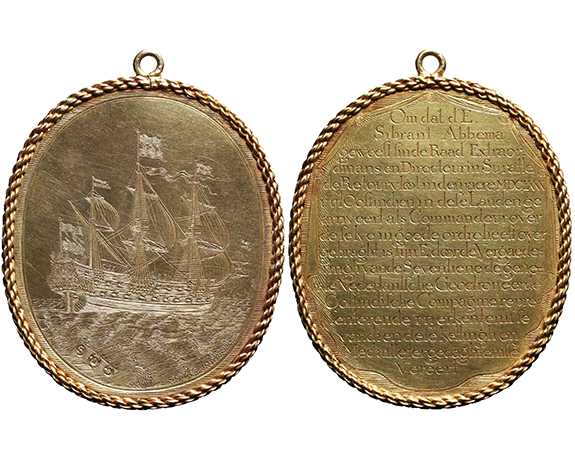
The medals of honour that hung from the chains are also known as ‘commander’s medals’. A small number have survived. In the second half of the 17th century, the Commander’s medal was an oval, engraved medal featuring a VOC ship on the obverse and an inscription on the reverse.
By the early 18th century, the oval, engraved medal had been replaced by a cast medal. The new medal also featured the VOC three-masted ship on the obverse and a blank shield on the reverse, providing space for the inscription.
Amsterdam and Zeeland medals
The Heren XVII met for six consecutive years in Amsterdam and then for two years in Zeeland. Unlike the chambers, the VOC’s executive board did not have its own organisation with staff. The chambers were responsible for implementing decisions, whilst the presiding chamber was responsible for the preparation and conduct of the meetings. This also applied to commissioning the gift that the meeting presented to the returning commander.
This means that the Commander’s medal and its accompanying chain were supplied by an Amsterdam goldsmith for six years and then by a master craftsman from Zeeland for two years. Of the three cast medals that have survived, two were made in Amsterdam and one in Middelburg – the medal awarded to Maarten Haringman in 1753. And yet the differences between the Amsterdam and Zeeland medals are minimal.
This must partly be due to examples such as the boxwood model. Unfortunately, even after extensive archival research, we do not know when or by whom it was made. However, it seems highly likely that it played a role in the manufacturing process.
Barely 15 grams. Not gold, but wood. Yet, very precious wood with a remarkable story.