

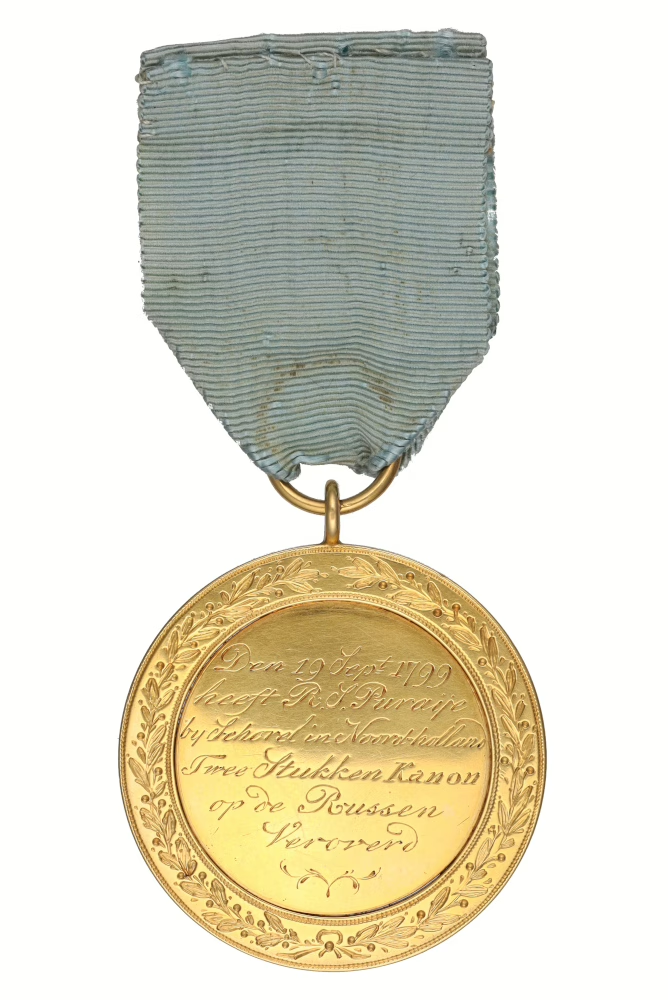


Medal for Outstanding Bravery, gold
The Medal for Outstanding Bravery (Gold) was established by Royal Decree on 18 July 1808 as a reward for non-commissioned officers, soldiers and sailors for acts of outstanding bravery.
The medal was awarded for the battle against the British-Russian invasion in 1799 near Bergen and Schoorl, and for the battles at Dömitz and Straalsund in northern Germany in 1809. The medals are engraved and are therefore all unique. There are a large number of later copies and reproductions, often with errors in the inscriptions.
A total of seven gold medals were awarded between 1808 and 1810.
General
| Start date | 1808 |
|---|---|
| End date | 1810 |
| Captions | voorzijde: LODEWYK. NAP. De Este: aan R.S. Puraije Sergt: Majr: van het 9de: Regimt: Infrie: tot Beloning van Dapperheid en Trouwe Diensten; keerzijde: Den 19 Sept: heeft R.S. Puraije bij Schorel in Nood-holland Twee Stukken Kanon op de Russen Veroverd |
| Dimensions [width] | 47 mm |
| Material | gold |
| Number | 7 |
Background
| Institutional decision | Royal Decree, 18 July 1808 |
|---|---|
| Additions | |
| Objective | Established as a reward for non-commissioned officers, soldiers and sailors for acts of outstanding bravery. |
| (Historical) context | |
| Producer | |
| Bibliography | Orders and Decorations of the Netherlands, 44–46 |
| Note | The Medal for Outstanding Bravery (gold) was awarded for the battles against the Anglo-Russian invasion in 1799 near Bergen and Schoorl, and for the battles at Dömitz and Straalsund in northern Germany in 1809. The medals are engraved and are therefore all unique. There are a large number of later copies and reproductions, often with errors in the inscriptions. |
Section
| In full | |
|---|---|
| Share | |
| Additions | none |


