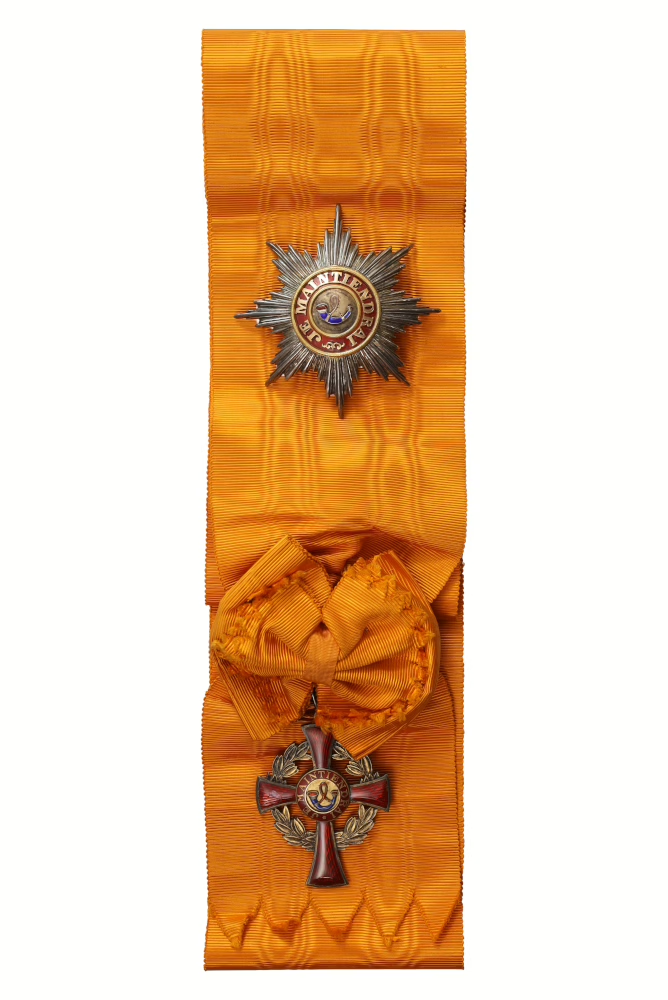


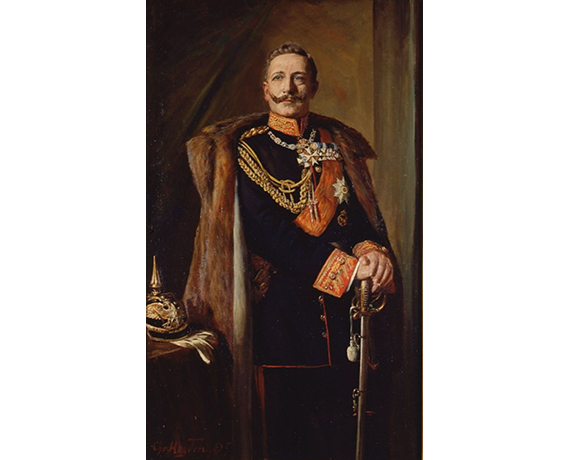

BERLIN – Yesterday, our envoy in Berlin, Jhr. van Tets van Goudriaan, presented the Emperor with the Grand Cross of the House Order of Orange. This extremely brief description appears in the *Zutphense Courant* of 16 June 1905. Fortunately, the official report that the envoy sent to the Foreign Office a few days later has been preserved. It contains a detailed account of the presentation, complete with some colourful details.
The Emperor and the Envoy
The emperor was none other than Wilhelm II. He had been on the throne since June 1888 as German Emperor and King of Prussia. The envoy who presented him with the insignia of the order was Jhr. Mr Dirk van Tets van Goudriaan. Van Tets van Goudriaan was a career diplomat. Before being appointed extraordinary envoy and minister plenipotentiary in Berlin in 1893, he had served at the Dutch embassies in Brussels, Vienna, Berlin, London and Constantinople.
The House Rules of Orange
By royal decree of 19 March 1905, Queen Wilhelmina founded the House Order of Orange. The new dynastic order was intended as a reward for services rendered to Us and Our House and made it possible to confer honours on individuals without political interference. The German Emperor was one of the first to be appointed to the new order.
An audience at the Neues Palais in Potsdam
On 14 June 1905, the Emperor received the Dutch envoy at the Neues Palais in Potsdam. Wilhelm II was dressed in the uniform of the Guard Hussars and wore the insignia of a Knight Grand Cross of the Military Order of William. Van Tets van Goudriaan intended to present the insignia of the new House Order with a brief speech, but the Emperor immediately struck up a conversation. After examining the insignia with great attention, he remarked that the colour of the ribbon was the same as that of the ribbon of the most important Prussian order of chivalry, the High Order of the Black Eagle.
Van Tets van Goudriaan replied that this was inevitable and also self-evident, because the Prussian King Frederick I, who founded the Prussian Order of Chivalry in 1701, had deliberately chosen an orange-coloured ribbon as a tribute to the House of Orange-Nassau. His mother was, in fact, Louise Henriëtte, daughter of Stadtholder Frederick Henry.
In 2003, the insignia of the House Order of the German Emperor were auctioned at the Dorotheum in Vienna. Since then, they have been in the possession of the Foundation for the Preservation of the Museum of the Chancellery of the Dutch Orders.
It is striking that the envoy was more familiar with the history of Prussian-Dutch relations than the Emperor.