Listen to the story, or carry on reading for yourself
____________________________________________________________
An insulting reward for the Emperor’s ambassador
The war in Holland, Utrecht and the other provinces of the Republic was entering its25th year in 1592 when an ambassador from Emperor Rudolf II arrived in The Hague. Otto Heinrich von Bylandt, Baron von Rheidt, had been sent to mediate between the warring parties.
The Eighty Years’ War (1568–1648)
In 1568, a revolt broke out against Philip II, the ‘King of Spain’ mentioned in our national anthem, who ruled the Low Countries as Lord of the Netherlands. The uprising led to the northern provinces renouncing allegiance to the king and jointly forming the Republic of the United Netherlands. The southern Netherlands remained subject to Philip II and Spain.
The Eighty Years’ War was fought on the territory of what is now the Netherlands, Belgium and Luxembourg. But the war was also a disaster for the neighbouring countries. The ports in the Netherlands formed an important link between England and the Rhine region, and between Scandinavia and southern Europe. That is why the German Emperor sent an envoy to The Hague.
An unsuccessful mission
Ambassador Von Bylandt had first travelled to the Southern Netherlands to discuss peace there. On 27 March 1592, he appeared before the States General in The Hague. The imperial envoy was received with every courtesy, but at the same time it was made clear to him that the Republic had absolutely no appetite for negotiations.
The gift for the ambassador
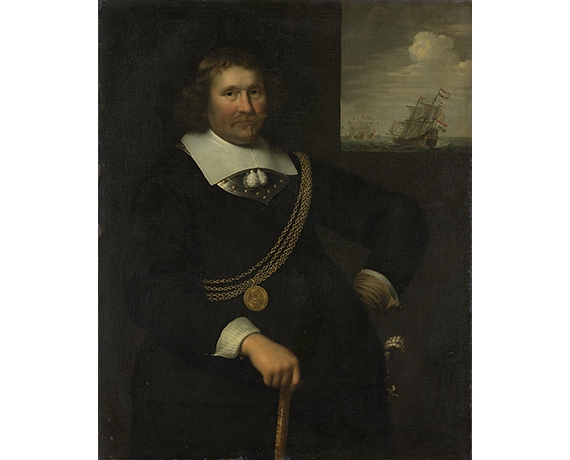
On 7 April, the States General decided to present the outgoing ambassador with the customary farewell gift: a gold chain and two medals. However, Von Bylandt refused to accept the gift on two occasions. No reason is given for the refusal. But if we look at the medals hanging from the chain, it seems clear why Von Bylandt refused the gift: the reverse of one of the medals depicts various Catholic monarchs. With blindfolds over their eyes, they are seated with their feet on a bed of nails. Among the monarchs, we recognise not only the Pope and the Spanish King Philip II, but also Emperor Rudolf II, the lord whom Von Bylandt represented. The Latin inscription leaves little to the imagination: ‘O blind minds of men, O blind hearts.’ That must certainly have been the reason why Von Bylandt refused the golden gift.
The States General used the parting gift they always gave to departing ambassadors and negotiators to make it clear once again that peace was out of the question. The Emperor’s ambassador understood the message and refused the gift offered to him.
All that glitters is not always GOLD!!
© The medal is held in the National Numismatic Collection, De Nederlandsche Bank.

Lorem ipsum dolor sit amet, consectetur a dipiscing elit, sed do eiusmod tempor incididunt ut labore et dolore magna aliqua. Ut enim ad minim veniam, quis nostrud