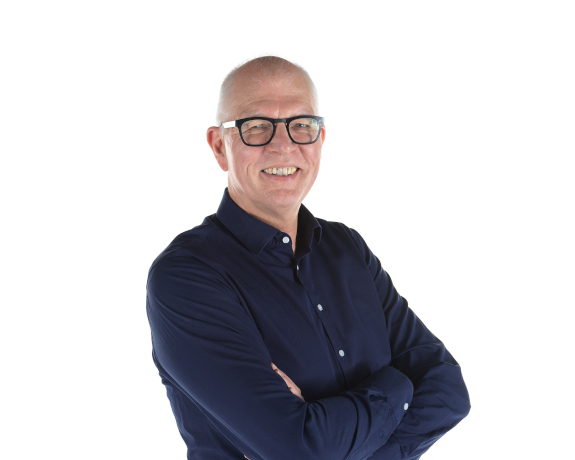
Hans Boetier
Since when have you been actively involved with orders of chivalry and honours?
I started collecting honours around 1988.
What is the reason or motivation behind your interest in orders of knighthood and honours?
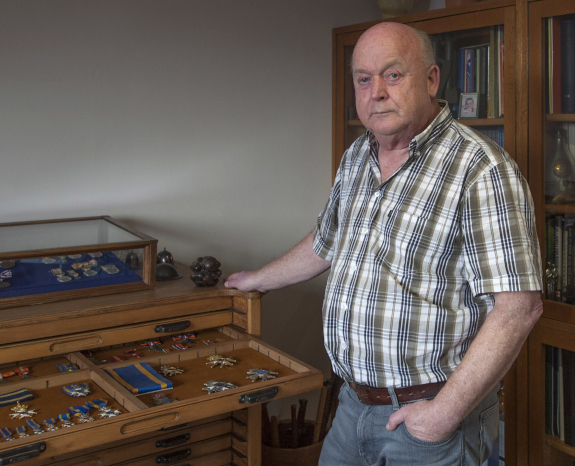
Having grown tired of collecting stamps, I was looking for something different. My neighbour had a Cross for Distinguished Military Service attached to his car keys as a key ring. That intrigued me. His father was Colonel Greter, the Olympic show jumper who had been awarded the Bronze Cross twice: the first time for the silent night raid in May 1940 and the second time, after he had escaped from Colditz, for his service in the Dutch East Indies. The miniature of his Bronze Cross bearing the number 2 and his complete set of original batons marked the start of my collection. Along with the Cross for Distinguished Military Service on the key ring, of course!
When I was posted to Germany, I was given the opportunity to attend an international course in Ashford (UK). It was there that I met Rogier Rijpkema. As course participants with our own transport, we spent the weekend exploring the areas around Battle, Hastings and Brighton. During our travels, Rogier visited every single medal dealer he could find. I went along with him. It only served to increase my interest even further.
Later, I was awarded an Iron Cross as well, and through my international contacts, many more besides. Well, as they say, a bird in the hand is worth two in the bush.
What is your area of interest?
My area of collection is the Kingdom of the Netherlands and, beyond that, anything I find beautiful and interesting. Later on – and, in fact, often too late – I also developed an interest in the accompanying certificates, cases, documents and other objects. That is how I search for stories. That is what I enjoy most of all.
My current interests lie in:
- The Flood Medals
- The House Order of Orange
- The Order of the Netherlands Lion
- Decorations of the Order of Orange-Nassau made in Portugal during the war years
- the Disaster Relief Brigade Medal and the Humanitarian Disaster Relief Medal
- The TMPT Cross
- The Oak Crown from the Dutch period
- The Four Days Marches Cross.
In doing so, I collect as many certificates, cases, related objects and information as possible. These are the things that make me happy!
Do you have any orders of knighthood or honours yourself?
The honours I have received are the result of an automatic process, of an administrative formality. For me, an honour is something you receive because you have achieved an extraordinary feat and for which you have been nominated by others. Hardly anyone understands anything about honours. That is why people think: the more honours someone has, the more important they are. But in fact, it is often just a matter of vanity.
And then there are all those buckles: surely you’d need a magnifying glass to make out what’s written on them! I believe that you are the only one who knows what you’ve done and what you’ve achieved. Personally, I see wearing decorations as showing off to others.
What is your favourite decoration and why?
I consider aesthetics and value to be of secondary importance; for me, the beauty of a decoration lies in the story behind it. For example, I used to have a set of four decorations in a canvas pouch. When I opened it, a terrible stench came out. They had belonged to a Papuan soldier who had enlisted in an Australian infantry regiment. After demobilisation, he returned to Papua New Guinea. So that he could still wear his decorations, he’d put them in a canvas pouch which he wore round his neck. As a sort of amulet. I got rid of that set. I regret it; but then, it’s too late now.
Which order of knighthood or honour would you yourself like to receive one day?
What others think I deserve. And a ‘thank you’ is also an honour.
And for collectors: the missing clasps of the Flood Disaster Medal, the insignia of the House Order crafted by Witte, and the Officer’s and Knight’s Crosses by Helder & Cunha of the Order of Orange-Nassau. With swords!!
Who do you think deserves a royal honour?
I believe that people should receive what they are entitled to. Above all, I am strongly opposed to automatic privileges, such as those enjoyed by members of parliament who have created an exceptional position for themselves. And I am opposed to what I call ‘filling the Christmas tree’.
Which Dutch researcher, collector or stakeholder would you like to pass the baton to?
Perhaps you shouldn’t be asking for names, but for areas or topics. At the moment, you’re dependent on whether someone is willing to be interviewed, or whether you can interview them in time.
Hans mentions three names, of which only the first is included in the interview, whilst the other two are already on the editorial team’s radar. The first person he mentions is Corstiaan de Haan. At the Ministry of Defence, he deals with the regulations governing honours, including the Long Service Medals. It is good to also give a voice to people outside the world of collectors. Corstiaan de Haan is at the centre of a vast network and is an important adviser to many.
Name Hans Boetier
Place of birth: Amsterdam
Year of birth 1952
Occupation: Retired officer in the Royal Netherlands Army
Contact address hmboetier@kpnmail.nl
Partnerships and stakeholders