


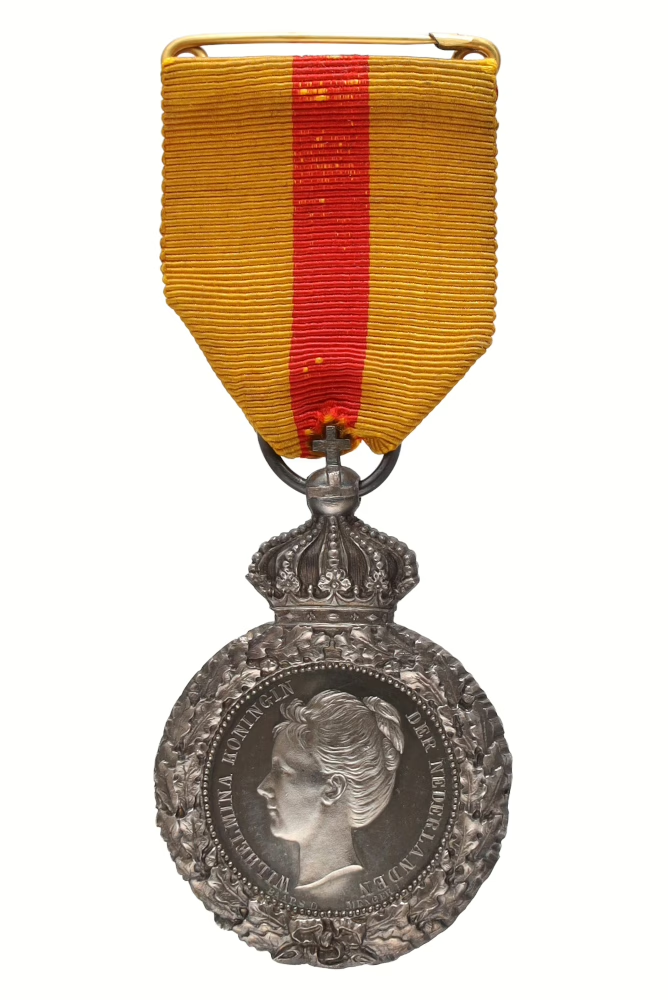
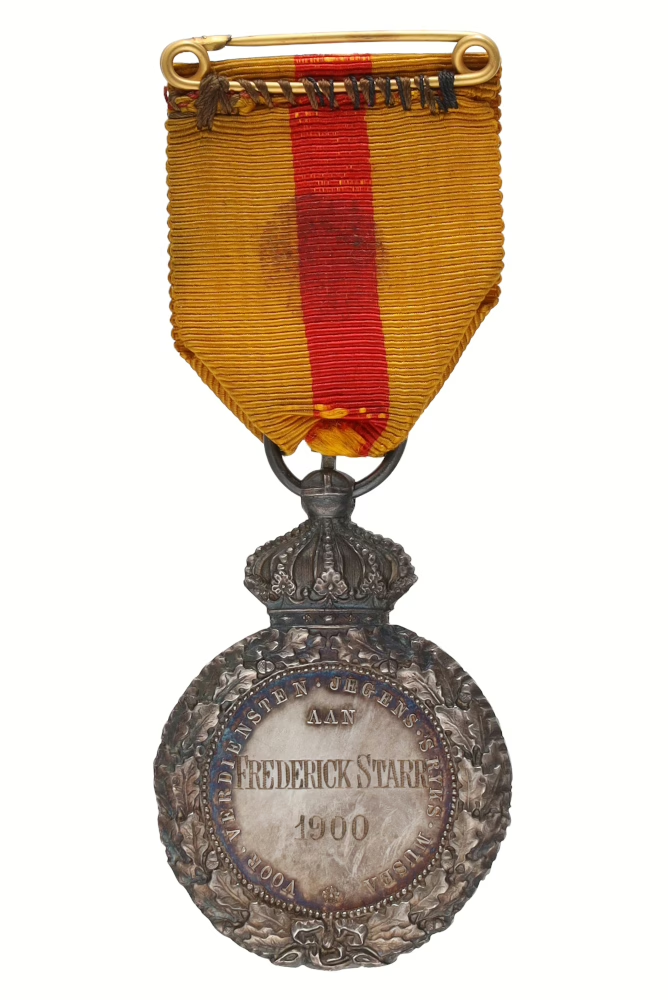

Medal of Honour for Services to Public Collections, 1897–1918 type
The Medal of Merit for Contributions to Public Collections is awarded in recognition of individuals who ‘have rendered outstanding service to the various scientific and art collections of the State, either by making significant donations or in other ways’. The 1897–1918 type was established by Royal Decree on 24 May 1897.
The Medal of Merit for Public Collections is usually referred to as the Museum Medal and was awarded in three classes: gold, silver and bronze. The medal was struck at the Royal Mint; the dies were engraved by Hendrikus Johannes Adrianus Baars. Twenty gold, 70 silver and 4 bronze medals were struck.
In 1918, a new version of the Medal of Honour for Services to Public Collections was introduced.
General
| Start date | 1897 |
|---|---|
| End date | 1918 |
| Captions | voorzijde: WILHELMINA KONINGIN DER NEDERLANDEN; keerzijde, omschrift: VOOR VERDIENSTE JEGENS ‘S RIJKS MUSEA; opschrift: AAN |
| Dimensions [width] | 34 mm |
| Material | gold; silver; bronze |
| Number | gold: 20; silver: 70; bronze: 4 |
Background
| Institutional decision | Royal Decree, 24 May 1897, No. 87 |
|---|---|
| Additions | |
| Objective | Awarded as a reward to people who ‘have rendered outstanding service to the various scientific and art collections of the State by presenting significant gifts or in other ways’. |
| (Historical) context | |
| Producer | The Royal Mint; Hendrikus Johannes Adrianus Baars |
| Bibliography | Orders and Decorations of the Netherlands, 146–147 |
| Note | The Medal of Honour for Services to Public Collections is usually referred to as the Museum Medal. The medal was awarded in three classes: gold, silver and bronze. The name of the recipient was inscribed on the reverse. The designer of the obverse, the young sculptor H.J.A. Baars, had drawn inspiration from the French Saint Helena Medal. |
Section
| In full | Medal of Honour for Services to Public Collections |
|---|---|
| Share | |
| Additions | none |


