


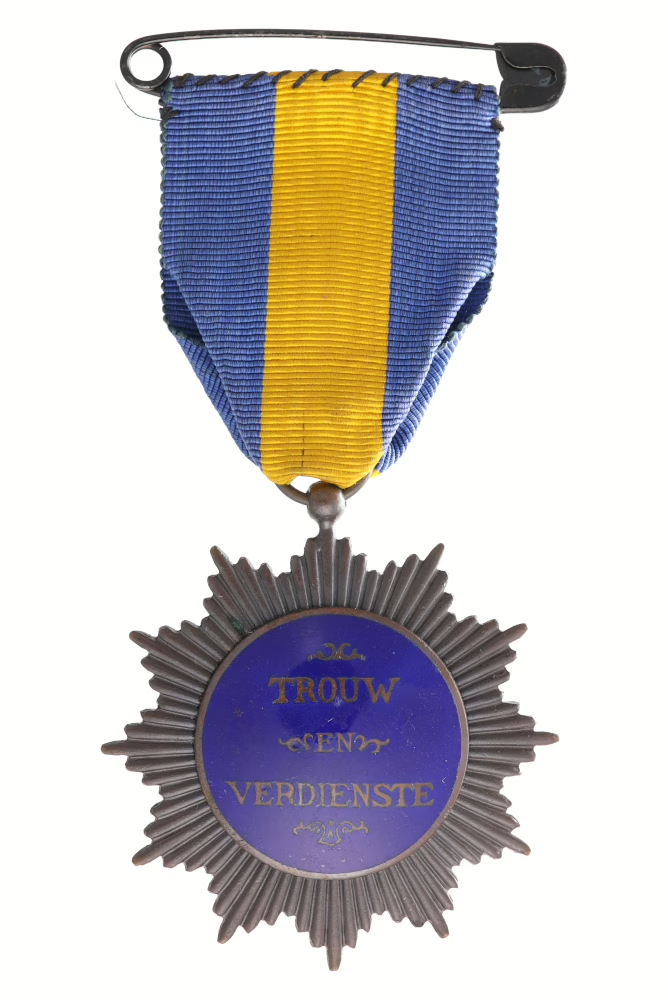

Star of Faith and Merit, bronze star
The Star for Loyalty and Merit was established by the Governor-General’s decree of 29 August 1893, No. 10, as a reward for deserving indigenous people. The Star for Loyalty and Merit initially had four classes. This was expanded to five in 1924.
The Star for Loyalty and Merit was established to replace the Medal for Civil Merit for Natives as a reward for “distinguished natives and other deserving Orientals”. The award was never officially abolished. The last award appears to have been made in 1962.
General
| Start date | 1894 |
|---|---|
| End date | 1962 |
| Captions | keerzijde: TROUW EN VERDIENSTE |
| Dimensions [width] | 52 mm |
| Material | bronze |
| Number |
Background
| Institutional decision | Decree of the Governor-General, 29 August 1893, No. 10 |
|---|---|
| Additions | Decree of the Governor-General, 1 April 1945 |
| Objective | Established to replace the Medal for Civil Merit of Indigenous Peoples as a reward for ‘distinguished indigenous peoples and other deserving Orientals’. |
| (Historical) context | |
| Producer | |
| Bibliography | Orders and Decorations of the Netherlands, 81–82 |
| Note | The Star of Loyalty and Merit was never officially abolished. The last award appears to have been made in 1962. After the Second World War, the ribbon was changed to a blue ribbon with a single yellow wavy stripe. |
Section
| In full | Star for Loyalty and Merit |
|---|---|
| Share | |
| Additions |


