


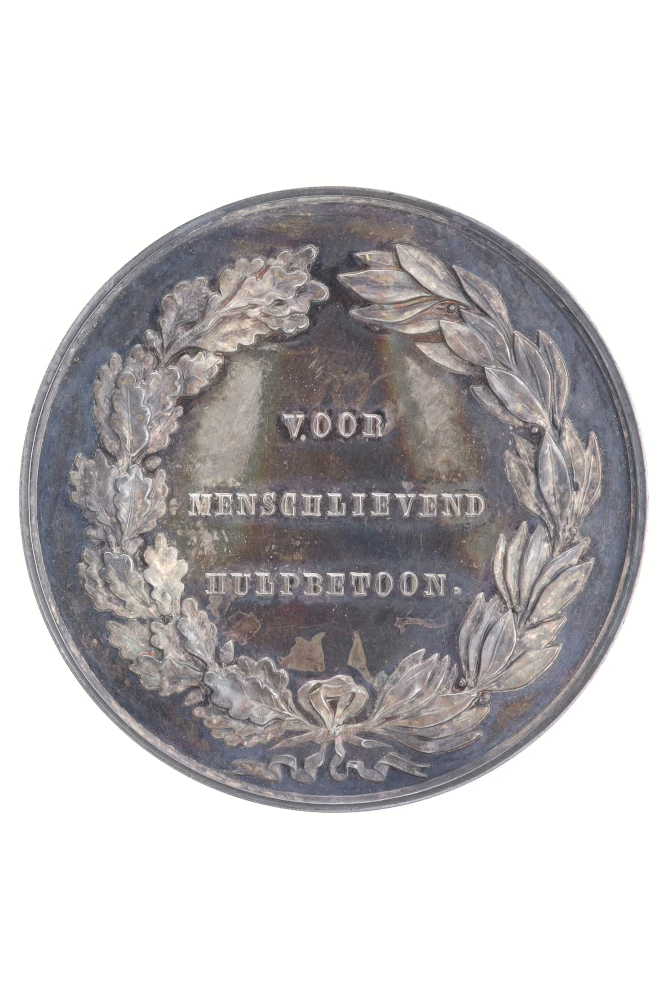

Medal of Honour for Acts of Humanitarian Aid, 1875–1890 type
The Medal of Honour for Acts of Humanitarian Assistance was established to recognise acts of humanitarianism characterised by courage, prudence and self-sacrifice.
The Medal of Honour for Acts of Humanitarian Assistance, type 1875–1890, was produced at the Royal Mint; the dies were engraved by Johan Philip Matthias Menger. A total of 61 silver and 751 bronze medals were struck.
General
| Start date | 1875 |
|---|---|
| End date | 1890 |
| Captions | voorzijde: WILLEM III KONING DER NED. G.H.V.L.; keerzijde: VOOR MENSCHLIEVEND HULPBETOON |
| Dimensions [width] | 50 mm |
| Material | silver; bronze |
| Number | silver: 61; bronze: 751 |
Background
| Institutional decision | |
|---|---|
| Additions | |
| Objective | Established as a reward for acts of humanity characterised by courage, prudence and self-sacrifice. |
| (Historical) context | |
| Producer | The Royal Mint; Johan Philip Matthias Menger |
| Bibliography | Orders and Decorations of the Netherlands, 129 |
| Note | The medal was awarded in two classes: silver and bronze. Gold Medals of Honour for Humanitarian Assistance awarded during this period were struck using the 1849 die, with a diameter of 41 mm. |
Section
| In full | Medal of Honour for Humanitarian Assistance |
|---|---|
| Share | |
| Additions | none |


