The Military Order of William of Van Speijk
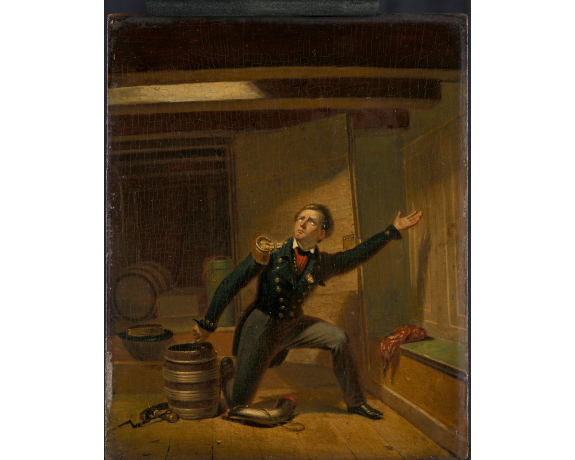
‘I’d rather blow it up’. Van Speijk is said to have uttered those words when he blew up his gunboat on the Scheldt. He did so to prevent his ship, which had lost its steering, from falling into the hands of Belgian rebels.
The Belgian Revolt
On 25 August 1830, the opera *La Muette de Portici* was performed in Brussels to mark King William I’s birthday. After the performance, riots broke out. Like an oil slick, they spread across the southern provinces. In the streets of Brussels, Dutch troops fought against Belgian insurgents. A month and a half later, a Provisional Government declared Belgium’s independence.
Antwerp
The Citadel of Antwerp remained in the hands of Dutch troops. On the Scheldt, patrolling Dutch ships controlled all traffic to and from the city. One of these ships was gunboat No. 2, under the command of 29-year-old Lieutenant (2nd Class) Jan Carel Josephus van Speijk. On 5 February 1831, a strong north-westerly wind and a faulty anchor caused the gunboat to drift ashore. When Belgian insurgents boarded the ship, Van Speijk stuck his cigar into a barrel of gunpowder. The explosion killed 26 of the 31 crew members and 7 Belgians.
The Van Speijk cult
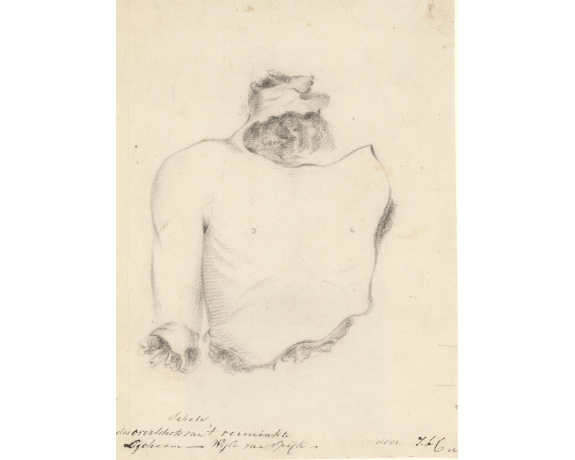
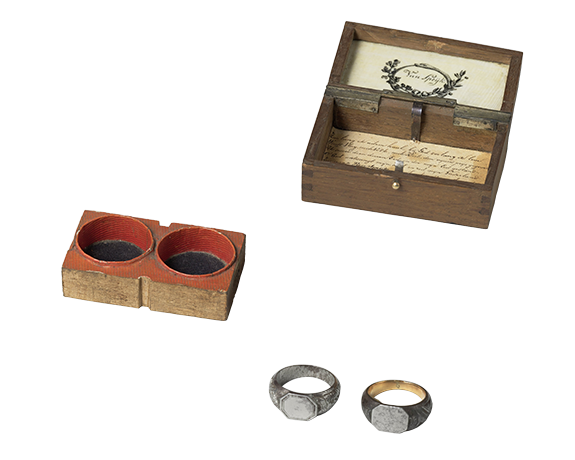
In the Netherlands, Van Speijk was regarded as a hero. Part of his body was recovered from the Scheldt four days later. His remains were laid to rest in the Nieuwe Kerk in Amsterdam. All manner of relics were fashioned from the metal and wood left over from the gunboat, most of which were accompanied by certificates of authenticity.
Historical evidence
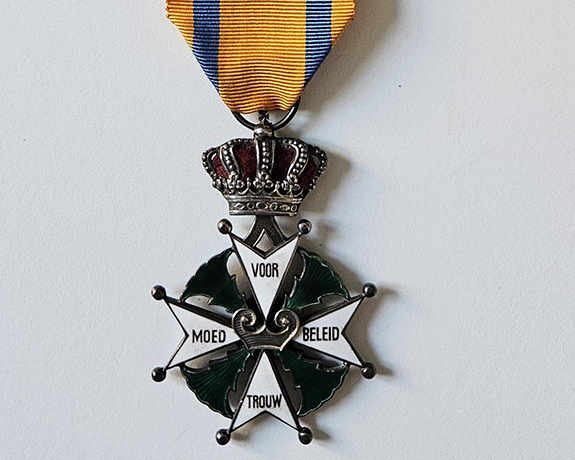
Van Speijk was a Knight ofthe 4th Class in the Military Order of William. His medal was recovered from the Scheldt River, attached to the remains of his jacket. Today, the blackened cross is part of the collection at the Naval Museum in Den Helder. In 2022, the programme *Historisch Bewijs* commissioned research into the medal. This included having the Netherlands Forensic Institute in The Hague simulate an explosion in a confined space. Two marks were also identified on the ring by which the crown was attached to the ribbon. These indicate that the medal was made in France in the1820s. Indeed, the Chancellery’s supplier had medals made in France during those years.
The twisted Order of the Cross reminds us of the remarkable act of Captain Van Speijk, who in 1831 chose to blow up his ship rather than fall into enemy hands.
With thanks to the Naval Museum, Den Helder.