He was not as well known as his contemporaries, Witte de With, Tromp or De Ruyter. But Jan Cornelisz Meppel eventually rose to the rank of lieutenant-admiral in the Northern Quarter Admiralty – the highest rank within that admiralty.
Career in the service of the North Quarter Admiralty
Of the five admiralties that existed in the Republic, that of the Noorderkwartier was one of the smaller ones. Meppel served there throughout his life and took part in campaigns in Denmark, the Mediterranean and against England. He fought in the Four Days’ Battle and took part in the famous expedition to Chatham in 1667. During that expedition, the Dutch fleet sailed up the Thames, where the English fleet was set alight and the flagship, the Royal Charles, was captured.
The portrait of a naval hero
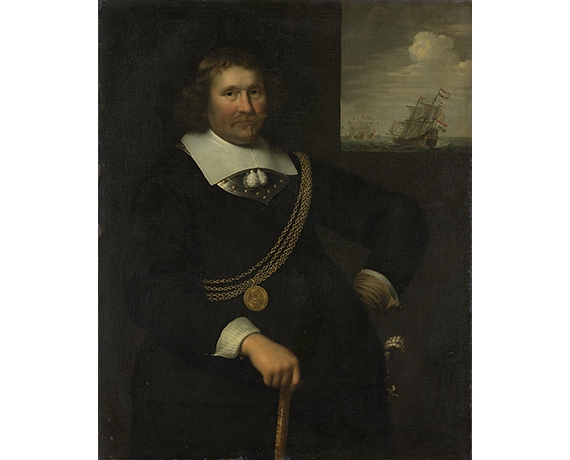
In 1661, Meppel commissioned the Hoorn-based master painter Jan Albertsz Rotius to paint his portrait. He gazes self-assuredly into the camera, his left hand resting loosely on his hip, his right hand leaning on his cane. For a17th-century viewer, there can be no doubt: this is the portrait of a naval hero. This is evident from the scene in the top right-hand corner: the ships engaged in battle. But the most important feature of this naval hero’s portrait is the gold chain that Meppel wears. It symbolises leadership and bravery.
The chain of Jan Cornelisz. Meppel
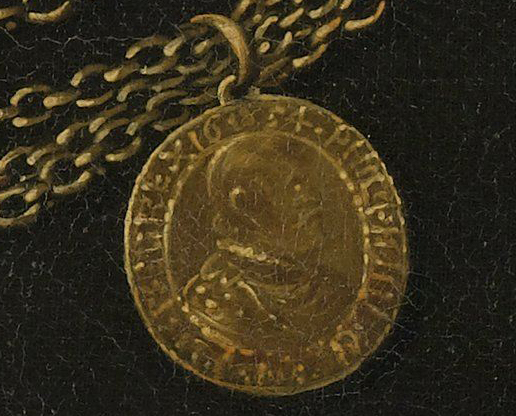
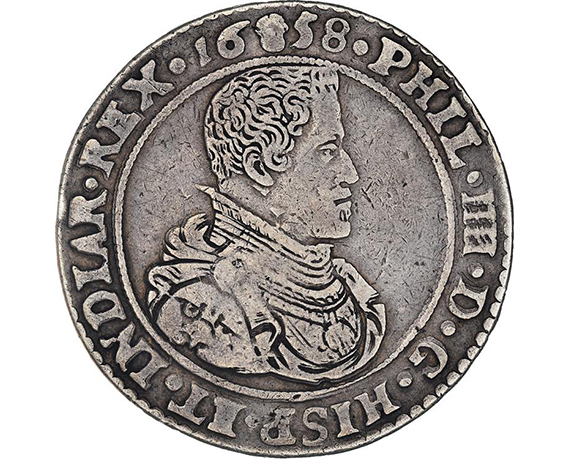
The chain worn by Meppel has four loops. This means it is wrapped round the body four times. We can even count the number of links and work out that the chain must have been worth around 800 guilders. The medallion hanging from the chain bears the portrait of the Spanish King Philip IV. If you look closely, you can even make out part of the inscription around the king’s portrait. Rotius did not simply paint such details from memory. Meppel must have posed for him, chain and all, so that the painter could examine the chain and the medal at very close quarters.
In a skirmish with a French fleet
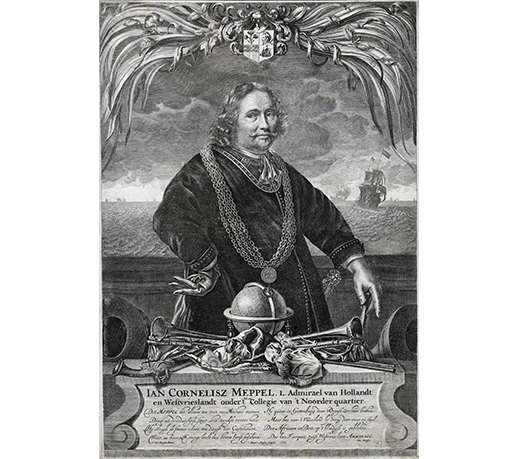
We now know what Vice-Admiral Meppel is wearing and that he received the chain from the Spanish King Philip IV. Strangely enough, it is much harder to say why he received this precious gift. The reason is that many of the archives that could provide an answer to this have been lost. Fortunately, an engraving from 1668 offers a solution. In the little poem beneath the portrait, we read:
Thus was the French fleet defeated whilst serving the Castilians
‘Where, beneath her King’s image, this brave breast shone’
France and Spain had been at war with each other for years. One of the theatres of war was the Mediterranean. To protect trade, the Republic sent ships to the Mediterranean every year. It was here that Meppel is believed to have engaged in battle with a French fleet around 1654. As a token of gratitude, he received a precious gold chain.
It is thanks to the portrait painted by Rotius that we know of the existence of Meppel’s gold chain. It is the portrait of a hero – a naval hero from Hoorn.