Lost at sea in the Java Sea
In late February 1942, an Allied squadron made a last-ditch attempt to prevent Japanese troops from landing on Java. On 27 February 1942, they encountered the Japanese invasion fleet in the Java Sea.
Combined Striking Force
The Allied Combined Striking Force consisted of 5 cruisers and 9 destroyers, of which 5 were from the US, 4 from the Netherlands, 4 British and 1 Australian. The Allied squadron was under the command of the Dutch Rear Admiral Karel Doorman.
In numerical terms, the two squadrons engaged in battle in the Java Sea were fairly evenly matched, but the Japanese ships were equipped with much heavier armament. As a result, the Japanese squadron’s firepower was many times greater. Furthermore, the air support received by the Japanese ships proved to be far more effective.
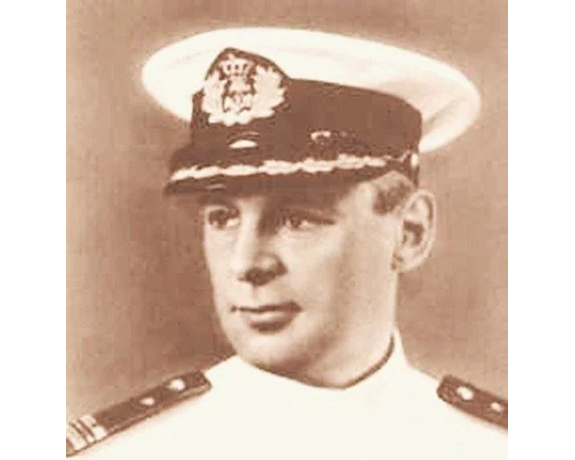
Eugène Lacomblé
After Eugène Lacomblé obtained his HBS certificate in 1914, he began officer training at the Royal Naval Institute in Den Helder. In 1917, he left for the Dutch East Indies. He pursued a career within the ranks of the Royal Netherlands Navy. Shortly before the outbreak of the Second World War, he was promoted to lieutenant commander. And when, from late 1941, preparations for war began in the Dutch East Indies as well, Eugène Lacomblé was appointed commander of the cruiser H.M.S. De Ruyter.
The Battle of the Java Sea
Even before the battle in the Java Sea had really got under way, the Allied fleet had already suffered significant losses. Two destroyers had already been sunk by the Japanese that afternoon. A third was badly damaged and had to return to Surabaya under the escort of one of the other destroyers.
By the evening, the situation had become much worse. The second British destroyer struck a mine, whilst the third was also forced to return to Surabaya with survivors from one of the sunken ships. The American destroyers, too, had to return to take on ammunition and fuel.
Shortly before midnight, Doorman gave the order ‘All ships … follow me’, which was mangled in a somewhat awkward Dutch translation into ‘I am attacking … follow me’. But the Allied ships were no match for the Japanese. The cruisers De Ruyter and Java were sunk, and the other ships only just managed to make a safe escape.
Awarded posthumously
The De Ruyter was struck amidships by a Japanese torpedo. Lacomblé ordered his crew to abandon ship. Together with Rear Admiral Doorman, he remained on board the sinking vessel. The battle in the Java Sea claimed the lives of more than 1,000 seamen, including 915 Dutchmen.
Eugène Lacomblé was posthumously appointed a Knight of the 4th Class of the Military Order of William by Royal Decree No. 31 of 28 May 1949.
In memory of the Dutch victims, the Karel Doorman monument was unveiled in 1954 at the cemetery of honour in Surabaya. The War Graves Foundation had bronze plaques fitted to the rear bearing the personal details of the Dutch victims. Among them was the name of Eugène Edouard Bernard Lacomblé.