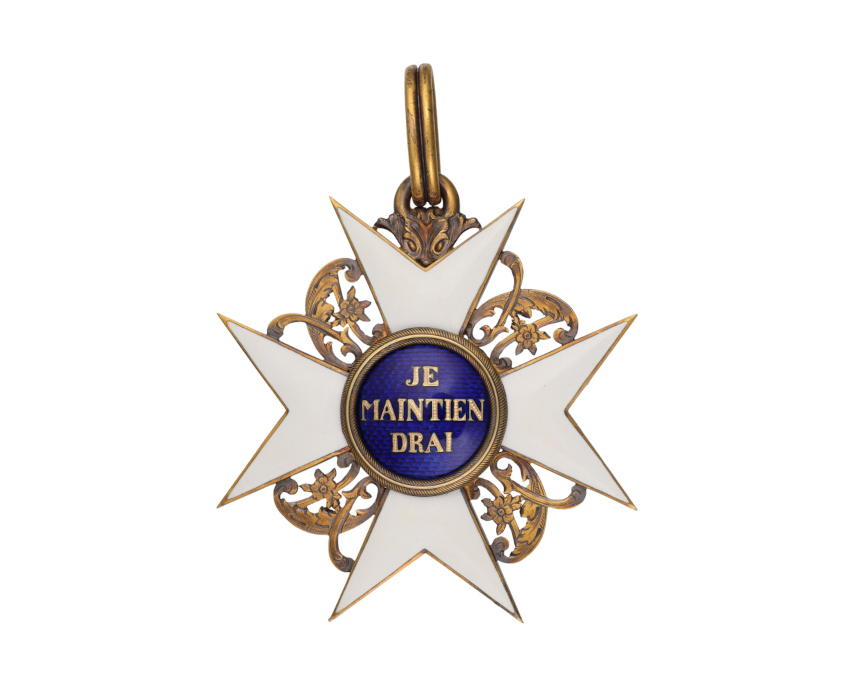
The Order of the Golden Lion of Nassau

As a symbol of the unity between the Ottonian and Walramian lines of the House of Nassau, in 1858 William III, in his capacity as Grand Duke of Luxembourg, and Adolf, Duke of Nassau, jointly established the House Order of the Golden Lion of Nassau. This order holds a special position because it has two Grand Masters. In the Netherlands, the order is a house order, whilst in Luxembourg it currently has the status of a state order.
The Order of the Golden Lion of Nassau

Test title

Originally, the order had only one class: that of Knight; but after the Duchy of Nassau was annexed by Prussia in 1866, William III, without Adolf’s consent, expanded the number of classes: by three in 1873 and by one more in 1882. Following the death of King William III, Queen Wilhelmina no longer had authority over the Order of the Golden Lion of Nassau. This changed in 1905 when an agreement was concluded between Queen Wilhelmina, as head of the Ottonian branch of the House of Nassau, and Adolf of Nassau, Grand Duke of Luxembourg, as head of the Walram branch of the House of Nassau. The agreement provided for the restoration of the order as a joint order of both branches of the House of Nassau, comprising a single class: that of Knight Grand Cross.

This highly exclusive order of chivalry is, in the first instance, reserved by birth for the princes, that is to say, the sons and brothers of both Heads of State. The insignia accompanying this honour may not be worn until the recipient has reached the age of majority. Consequently, none of the female heirs to the Dutch throne could be admitted to this order by birth. However, this does not preclude them from being appointed to this order by other means. Wilhelmina would never be accorded such an honour, but Queen Juliana and Prince Bernhard were appointed to this order during a state visit to Luxembourg in 1951. Nor was Queen Beatrix ever admitted to the order. On 30 April 1980, the day of their mother’s coronation as Queen of the Netherlands, the three sons of Beatrix and Claus were, by virtue of their status as sons of the Grand Master of this Order in the Netherlands, legally conferred the rank of Knight Grand Cross of the House Order of the Golden Lion of Nassau. From the age of eighteen, they wore the insignia on their uniform or tailcoat.

The King of the Netherlands and the Grand Duke of Luxembourg may both appoint individuals to the Order of the Golden Lion of Nassau, either on a joint nomination or individually. In the Netherlands, this honour is awarded very rarely. Well-known examples include the awards presented to Dr M. van der Stoel on 31 August 1999 and to Prof. Dr P.H. Kooijmans on 28 November 2006. In 1999, Queen Beatrix and Grand Duke Jan jointly awarded the Golden Lion of Nassau to the South African President, Nelson Mandela.

Development 1858–1873

On 31 March 1858, the Order’s statutes were published and the first awards were made. The first appointments to the Order were the sons and brothers of the heads of the branches, as the statutes stipulate that they are knights by birth. The right to confer the Order rests with the heads of the two Nassau lines, and the Luxembourg Minister of State holds the office of Chancellor of the Order. The Order could be conferred jointly by the Nassau lines, but this was usually done on the initiative of one of them. When a decoration was conferred on one’s own initiative, the other sovereign was informed so that both remained aware of who had been appointed to the Order. In the early years, the number of appointments made by Adolf of Nassau was significantly higher than the number made by William III. The difference in numbers can be explained by the fact that the King of the Netherlands had several orders of chivalry at his disposal.

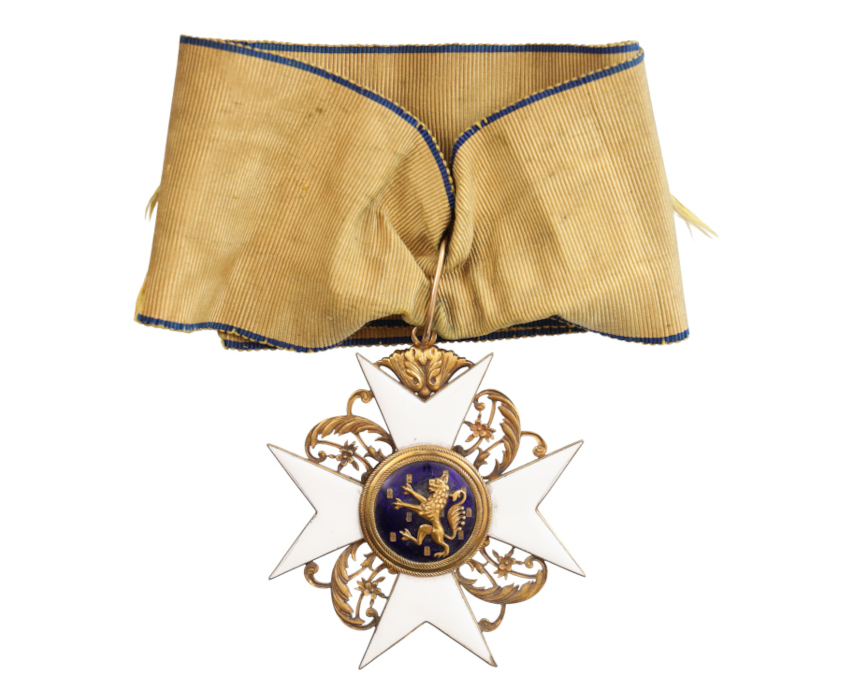
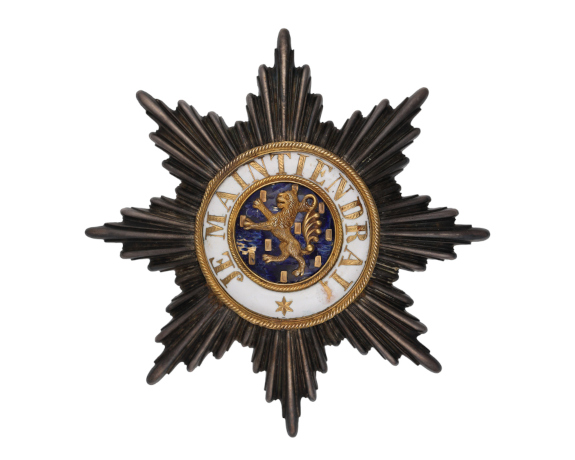
Knights of the Order of the Golden Lion of Nassau wear the jewel on a sash approximately 105 millimetres wide. The size of the jewel is not specified in the Order’s statutes, but the known examples are 75 millimetres wide and thus strikingly large. In addition to the sash, a Knight wears a breast star. This breast star has eight rays with the Lion of Nassau at its centre. Surrounding the lion is the inscription ‘Je Maintiendrai’.

Test title

Development 1873–1882

In 1866, the Duchy of Nassau ceased to exist as an independent state. Consequently, King William III no longer felt bound by previous agreements made with his cousin Adolf. Furthermore, the King felt a strong need to be able to confer the order on those of lower rank as well. Consequently, in 1873, without Adolf of Nassau’s consent, a new Act was passed. With the enactment of this Act, three new classes were added to the existing order.

The Knight 2nd Class wore the jewel on a neck ribbon 56 millimetres wide, accompanied by a four-pointed breast star. Unlike the width of the ribbon, the width of the jewel and the breast star is not specified in the statutes. The known examples consist of a jewel approximately 60 millimetres wide and a breast star 63 millimetres wide. The number of Knights of the 2nd Class was not to exceed 48.

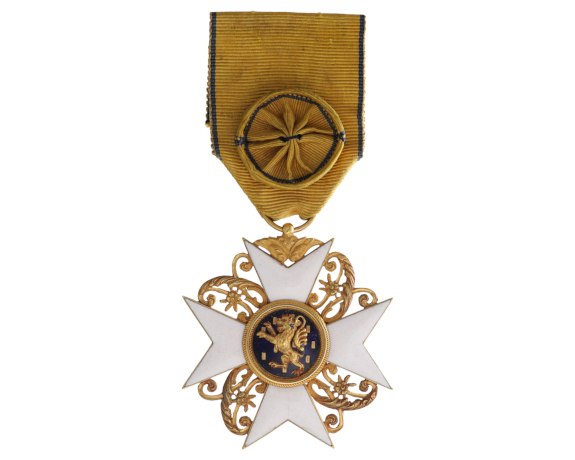
The Knight 3rd Class wore the medal suspended from a ribbon 37 millimetres wide, with a rosette. The width of the medal is the same as that of the Knight 2nd Class medal and is therefore approximately 53 millimetres wide. The number of Knights of the 3rd Class was limited to 96.

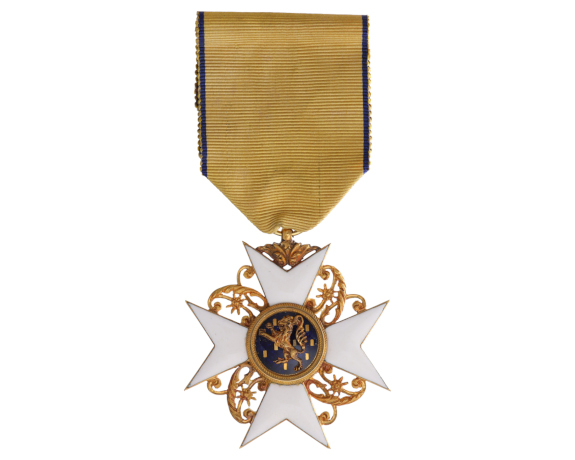
The 4th-class knight wore the jewel suspended from a ribbon 37 millimetres wide. The width of the jewel is described in the statutes of 1873 as ‘slightly less wide than the 3rd-class jewel’. During this period, the width of the 4th class jewel was 45 millimetres. The number of 4th class knights was not to exceed 192.

In a number of cases, a knight was promoted within the order. Should a knight be awarded a higher rank, the insignia of the lower rank had to be returned to the Luxembourg secretariat.

Development 1882–1892

In 1882, on the initiative of King William III, the order was further expanded. By 1882, the order comprised a total of five classes, bringing it more into line with other European orders of chivalry. Compared with 1873, a new 3rd class of knighthood was added after the old 2nd class. In addition, the new 4th and 5th classes were adjusted in size. Finally, the two highest classes were given a separate military division by adding swords to the breast stars. The order now consists of the following classes:

The Knight 1st Class remains the same, but is supplemented by a military division. This military division differs from the civilian version by the addition of two gold swords to the breast star.

The Knight 2nd Class remains the same, but, as with the 1st Class, is supplemented by a military division, also recognisable by the added swords on the breast star. The number of Knights 2nd Class was not to exceed 48.

The Knight 3rd Class wore the medal on a neck ribbon 56 millimetres wide. The medal itself is 53 millimetres wide. As with the Knight 2nd Class, the number of Knights 3rd Class was limited to 48.

The Knight 4th Class wore the medal suspended from a ribbon 37 millimetres wide, with a rosette on the ribbon. The width of the medal is described in the statutes of 1882 as ‘smaller than the 3rd Class medal’. During this period, the width of the 4th-class medal was 39 millimetres. The number of 4th-class knights was not to exceed 196.

The Knight 5th Class wore the medal suspended from a ribbon 37 millimetres wide; the statutes specify that the width of the medal is the same as that of the Knight 4th Class, and therefore also measures 39 millimetres. The number of 5th-class knights was limited to a maximum of 192.

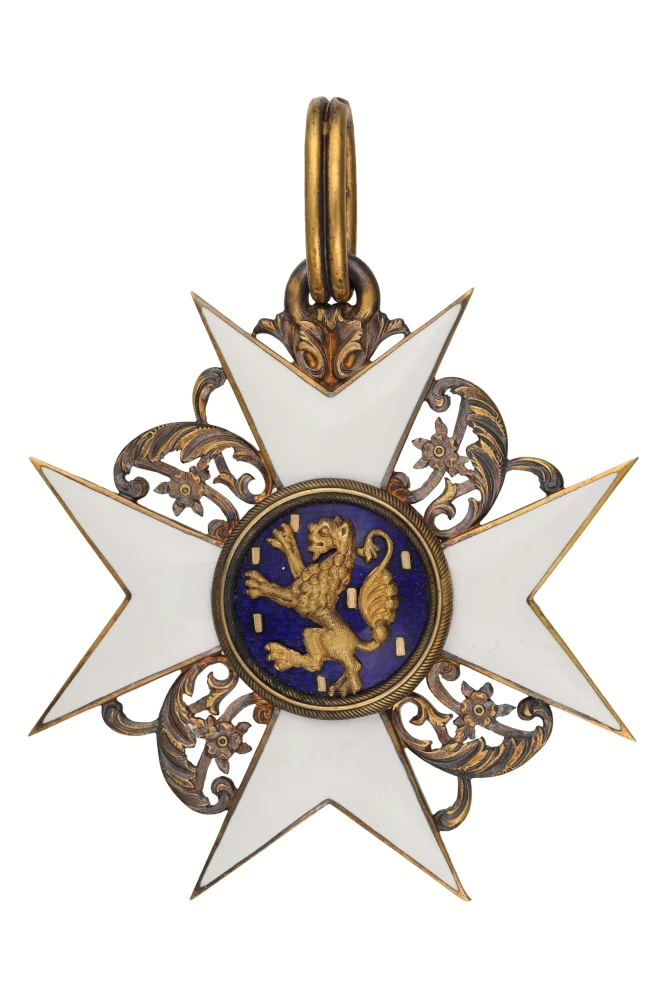
The Order of the Golden Lion of Nassau, Knight, Second Class, an order established in 1873, Grand Officer (obverse)
Gallery image
Gallery image 1
Gallery image 2
Gallery image 3
Gallery image 4

Test title

Development from 1892 to the present day

Following the death of King William III, the personal union with Luxembourg came to an end. Adolf became Grand Duke and was thus able to exercise full authority over the Order of the Golden Lion of Nassau and the Order of the Oak Crown. Adolf decided to reduce the number of ranks back to one; after all, he had never recognised the changes of 1873 and 1882. This decision was implemented in 1892 when the old Act of 1858 was reinstated. From 1890, when the personal union with Luxembourg ended, the Netherlands could no longer hold the Order of the Golden Lion of Nassau. Queen Wilhelmina nevertheless found she needed a royal order, and so a request was made to Adolf to regain possession of the Order of the Golden Lion of Nassau. In 1905, an agreement was reached between the Netherlands and Luxembourg, on the condition that the order would henceforth have only one class.

Sources:
Van Geldorp et al. Verdiend Eerbetoon, 2016.
Biemans et al. The Order of the Golden Lion of Nassau, 2018.
This text was previously published on the website of the Museum of the Chancellery of the Dutch Orders.

Test title
0
+
Knight, 1st Class
0
Knight, 1st Class, with swords
0
Knight, 2nd Class (1873–1892)
0
Knight, 2nd class, with swords
0
Knight, 3rd Class (1873–1882)
0
Knight, 3rd Class (1882–1892)